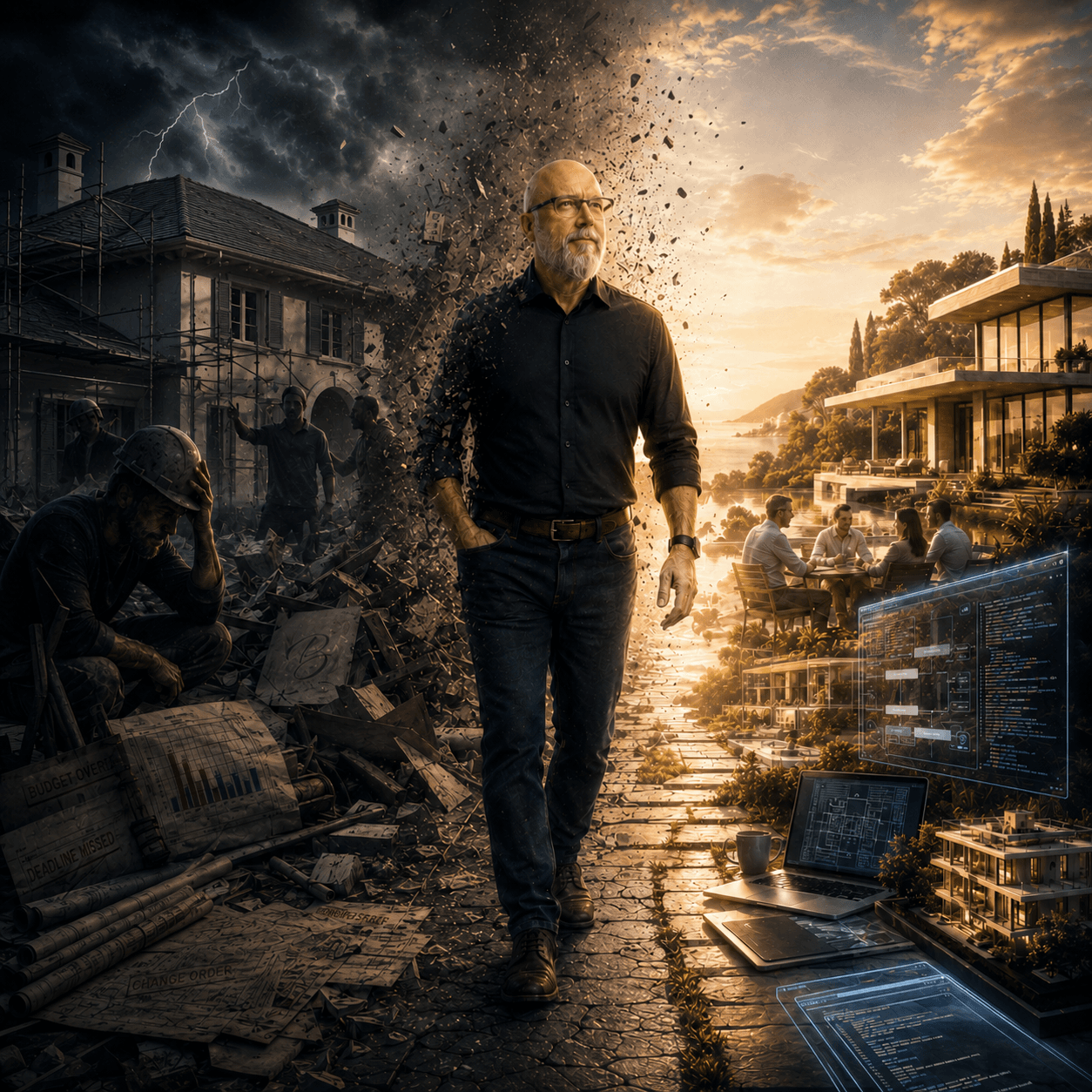
You might have heard I had a breakdown. It was more like a breakthrough.
The Exit
A couple of years ago, I walked away from a situation that was no longer solvable. I had spent years in ultra-high-end custom residential construction building multi-million-dollar projects, and I'm still a licensed general contractor. I'm genuinely good at the building and project management side of it.
But over time I came to believe the model I was working inside was broken.
In cost-plus construction, you're asked to tell clients what their project will cost before the full specs exist. The architect is usually designing a house the client doesn't really want to pay for, while ten other GCs are willing to quote overly "optimistic" numbers just to get the job. When the real cost shows up, the relationship can turn adversarial no matter how well you manage it.
I had always been good at finding a way through hard problems, but this one started to feel like a problem I didn't actually want to solve anymore. It felt like there was no real winning in the organization, at least not for the kind of work I wanted to do, where the goal was to build something well and have the client feel good about the process when it was over.
Then, one day I just stopped. I decided I wasn't going to spend the rest of my working life fighting a model I no longer believed in. And as a heavy user of AI from the beginning, I could see something most of the world was still not paying attention to: this technology was going to shock a lot of industries. How could I watch that coming and do nothing but stay in a job that made me miserable, in an industry I already believed needed disruption?
I honestly felt like a blacksmith watching the new Ford plant being built down the street.
The Plan, Kind Of
So I had a plan.
Kind of.
My wife Amy is a serial entrepreneur and esthetician with a strong business in Roswell that she had long since outgrown as a one-person operation. Her books were full, her clients were loyal, and she had more knowledge than she could possibly deliver one appointment at a time. She wanted to teach younger estheticians how she had built something that worked, and to help more women with their skin than her schedule would ever allow.
We also wanted a different kind of life. More travel. More freedom. More meaningful work. Less of the grind that looks successful from the outside but slowly takes the joy out of everything. Our life had room for a reset, and we decided to take it seriously.
So we came up with a plan that was simple enough to say, much harder to do: bring on and train more estheticians, modernize her systems, and build the studio into something that could run beyond just Amy in a room. At the same time, we would endeavor to capture and monetize Amy's "secret sauce" — the blend of her skincare and relational expertise that has made her so successful.
That meant we were really going into a building phase. Not a construction project this time, but still a build. We needed better systems, documented SOPs, content, lighting, training materials, client workflows, marketing, a tech stack, and a structure other estheticians could actually learn from.
Someone had to build all of that, and as the resident builder, that someone became me.
The New Job Description
I grew up using computers, and I have always reached for software or technology whenever I needed to solve a problem. But this was different. My new job description was basically every problem: video, marketing, booking systems, data, e-commerce, payroll, client records, and whatever else broke or needed to exist.
I was going to need better tools to make all of it work. And I was going to need to level up fast.
I had been using AI obsessively from the beginning, as a way to learn faster, write better, analyze problems, troubleshoot systems, and push through things I didn't yet know how to do. I wasn't a trained developer. I wasn't pretending to be one. But I was comfortable being dangerous with new tools, and when I'm after something, I don't quit. Being armed with this new intelligence gave me some confidence.
And none of this was as far from construction as it looks. Alongside my construction career, I had also lived a whole other entrepreneurial life: an import business that let me travel the world, two retail stores, a recording studio, and fourteen years of helping build Amy's studio. Different surfaces, same job underneath: keep complex plans moving forward without dropping the details and find ways to take friction out of the work.
So I Started Building
So I started building.
First, the physical business: recruiting and hiring our first esthetician, building out another treatment room, acquiring equipment, upgrading the spa, and helping turn Amy's one-room practice into something with more capacity.
Then the media and marketing side: filming training materials, creating content for the brick-and-mortar business, writing copy, shaping offers, running ads, and trying to explain what Amy did in a way that could actually travel beyond the treatment room.
Fortunately, the production experience from my previous life showed up like the cavalry. So did the copywriting and messaging experience I had picked up over the years — from skincare pages that ranked the studio on Google to construction emails where millions of dollars depended on clarity.
The First Real Test
The first real test was client data.
Amy had been on Booker for close to a decade, and for all its limitations, it worked. But we wanted a more modern presence, better online booking, and tools that fit where the business was headed. So just before I left my job, Amy migrated to Square Appointments after another med spa owner recommended it.
It seemed fine at first. But once we hired our first esthetician and started running more clients through the system, every little gap became a crisis. Amy runs a results-based skincare clinic. She needs to know, quickly, what active ingredients she has used on a client's face, what that client has purchased for home care, how their skin responded, and how all of that connects over time.
That is not a nice-to-have. It is the model. Without that information readily accessible, you risk everything from lost sales to, more importantly, the client experience.
And between clients, she may only have a few minutes to turn the room, review the record, and make the next decision. The information she needed was either buried, missing, or not connected in a way that matched how she actually practiced.
Amy was already carrying a heavy load, and this system was making it worse. No amount of tweaking settings could fix the fact that it simply wasn't built for how she worked. What looked like a minor inconvenience on the surface quickly turned into a real operational problem.
So I went to work.
I set up a way to sync data out of Square into Airtable, a lightweight database platform. That allowed her to quickly pull up comprehensive historical client data on the fly — something Square, despite marketing itself to med spas, somehow failed to make usable.
From there, I built a dashboard and the underlying tables to create a proper historical client notes section, again filling in a gap Square didn't seem to think mattered. Next was a home-care flow that allowed us to record clients' routines and share them clearly, so clients actually knew what to do between visits.
Somehow I was back dealing with the gaps software platforms don't solve, or ignore completely.
And I was enjoying solving them.
After the triage, I made the call to move us to Boulevard.
Boulevard was built for medspas and higher-end esthetics, and it gave Amy enough of what she needed to breathe again. But the real turning point, at least for me, was that the enterprise account came with something Square had not given me: API access.
That opened up a new world for me.
Not overnight. Slowly. Painfully. One deep dive at a time. I would spend hours trying to understand one API call and come away with just a little more clarity about what I could and could not reach. But for the first time, I could see a path to the thing I had always wanted from software: not just using whatever screens the platform gave me, but reaching into the data itself and building the workflows the business actually needed.
The Boring Problem
The boring problem that kept me going was payroll.
Our payroll calculation was designed around outcome: a minimum hourly rate or commission, whichever was greater. Different employees. Different service totals. Tips. Product sales. Clean weekly records. No room for guessing and no desire to do it manually forever.
It was not glamorous. It was not some futuristic AI demo.
It was just a real operational problem that needed to be right every single week.
And because it had to be right, it forced me to go deeper into data and automations than I had gone before. I was being guided by ChatGPT, which in those days could be profoundly helpful in one session and completely lost and hallucinating in the next. These were deeper problems than asking for help with recipes or algebra, and I was routinely hitting the limits of this new technology.
From Fixes to Architecture
That was where the work started to change.
At first, I was still thinking in terms of fixes. Patch this. Connect that. Build a dashboard. Create a form. Automate a reminder. Generate a report.
But over time, the work became less about individual fixes and more about architecture. How should the information move? Where should the source of truth live? What does Amy need to see quickly? What should her assistant be able to update? What should be automated, and what still needs a human decision?
Those questions were not really software questions.
They were operating questions.
The same kind I had spent years answering in construction, just with different materials.
Plans Meet Reality
And of course, plans are just plans. Mike Tyson said everyone has a plan until they get punched in the face, and we caught a few. The studio was progressing, but not on the timetable we had hoped. Getting clients to accept someone who wasn't Amy took longer than expected. Figuring out the Meta algorithm was not exactly a day-one solve. We had more than enough material for a course, but not enough clients supporting the new esthetician, so we doubled down on marketing the studio.
Eventually, within the limits of what is possible for a local brick-and-mortar business, the videos and marketing started working. We brought in a lot of new clients. But that also pulled Amy back into the treatment room and slowed down the course we had originally hoped to build.
So now I had all these systems that needed me to run them, but not enough to justify spending all of my time only on our own businesses. I had a whole career of experience behind me, so I started working with a few select clients in the industry on technology and operations consulting.
That was useful, but clarifying.
Most owners say they would love to make things easier. But when it comes time to change how the work actually gets done, a lot of people are understandably resistant. They are busy. They are tired. They are just trying to get through the week.
So I started to realize this kind of work would be great when there was real alignment, but I was not going to center my career around trying to convince reluctant people to change. I had already lived versions of that before. I could either keep trying to persuade other people that something was worth building, or I could build for my own ventures and reap the benefits.
I had this whole toolbox of new skills and abilities, and for the first time in a long time, the time and space to decide how and for whom I wanted to use them.
Estate South
Then came the idea for Estate South, and that pushed the whole thing further.
The Estate South concept came from the construction side of my life. I had seen too many owners of significant homes stuck between contractors, vendors, maintenance issues, insurance problems, deferred repairs, and no real system for understanding what needed to happen across the property. They did not just need someone to show up when something broke. They needed someone in their corner, putting the house on a schedule and a plan, then helping watch the property over time.
That was the idea: property stewardship, backed by real construction judgment and better systems.
Truthfully, I came up with the concept because I wanted a part-time job. But then the first concept video was so positively received that we started thinking maybe this was the thing I should build. And because I am always a systems-and-builder guy, my thoughts immediately went to the "how." How do I make this feasible? What is the tech stack? How do you manage the client experience? How do you solve for the operational and data requirements underneath it?
That was when I picked up AI-assisted coding for real, and I was off to the races.
Within a few hours, I had the property audit application wired up to Airtable. It was a completely different level of control. Not just pages that looked good. Tools that did exactly what they needed to do. If I needed a feature, it was mostly limited by time and imagination, and imagination has never really been my problem.
Within weeks, I had built two more applications around the first one. But they were still three separate apps that I had basically stitched together with the same navigational menu.
I had already architected myself into a corner.
So I started asking what the better version should look like. Instead of just solving the current issue, I needed to look ahead. How would clients log in and see only their own data? What flows would keep fragmented information, approvals, photos, notes, and recommendations surfaced and visible? What needed to be secure? What needed to be shared? What needed to be automated?
That first migration ended up being to a proper database with row-level security, built on a new coding platform that poured gasoline on the fire that had already been stoking inside me.
The features I could add, the problems I could solve, the workflows I could build — all of it suddenly felt limited mostly by time and imagination. Then I built my first code-only website, which quickly turned into three more, but now plugged into actual application scripts that did everything from monitoring keyword rankings to supporting client proposal and contract flows.
These were things I could never have built so seamlessly with Zapier and off-the-shelf tools alone.
Then I started building new applications around Boulevard to solve for the operational gaps it did not address at all, or did not address well. Then a platform to help me manage everything across the businesses. I began creating software prolifically, while cancelling subscriptions that had been costing us thousands over the course of each year.
Build, Break, Rebuild
That became a pattern too.
Build until the current level of understanding breaks.
Learn the next thing.
Rebuild better.
What's Running Now
We now have several ventures running in parallel: Amy's studio, a new skincare line, virtual consultations, software projects, and a Shopify store — all things that support the course we set for our lives over the coming years.
My focus has also returned to the construction side, but in a way where I can actually be helpful: owner's representation in the luxury custom space. It gives me a way to address some of the issues I encountered in that market, while applying a new set of tools to bring more clarity to clients around their project data.
I am also working with a small number of clients piloting the Estate South model as I look toward strategic partners who can help grow that concept into the business I believe it can become.
At this point, I have more than five deployed platforms, two autonomous agent systems working inside them, and a number of middleware and custom solutions that help manage our finances, billing, marketing, and operational needs. I have never been more excited about the possibilities in this new world.
Somewhere along the way, I realized I was not just using tools anymore. I was building the layer between the business and the software — the missing operating layer that made the tools actually fit the way the work happened.
Digital Ops Box is the place I built to share what I have been building, follow my excitement around what is possible, and occasionally work with other entrepreneurs who, like me, do not only want to ask "what is possible?" but are ready to actually build it.
The Bigger Version of Building
I left my previous role in construction thinking I was stepping away from building.
What actually happened is that I found a bigger version of it.
From construction, estate management, project management, retail, importing, content, a skincare studio, and now software — the work never really changed that much. I was always trying to understand the moving parts, find the operational friction, and build the missing piece.
The work did not change.
The toolbox just got bigger.
You might have heard I had a breakdown.
I didn't.
It was a breakthrough.