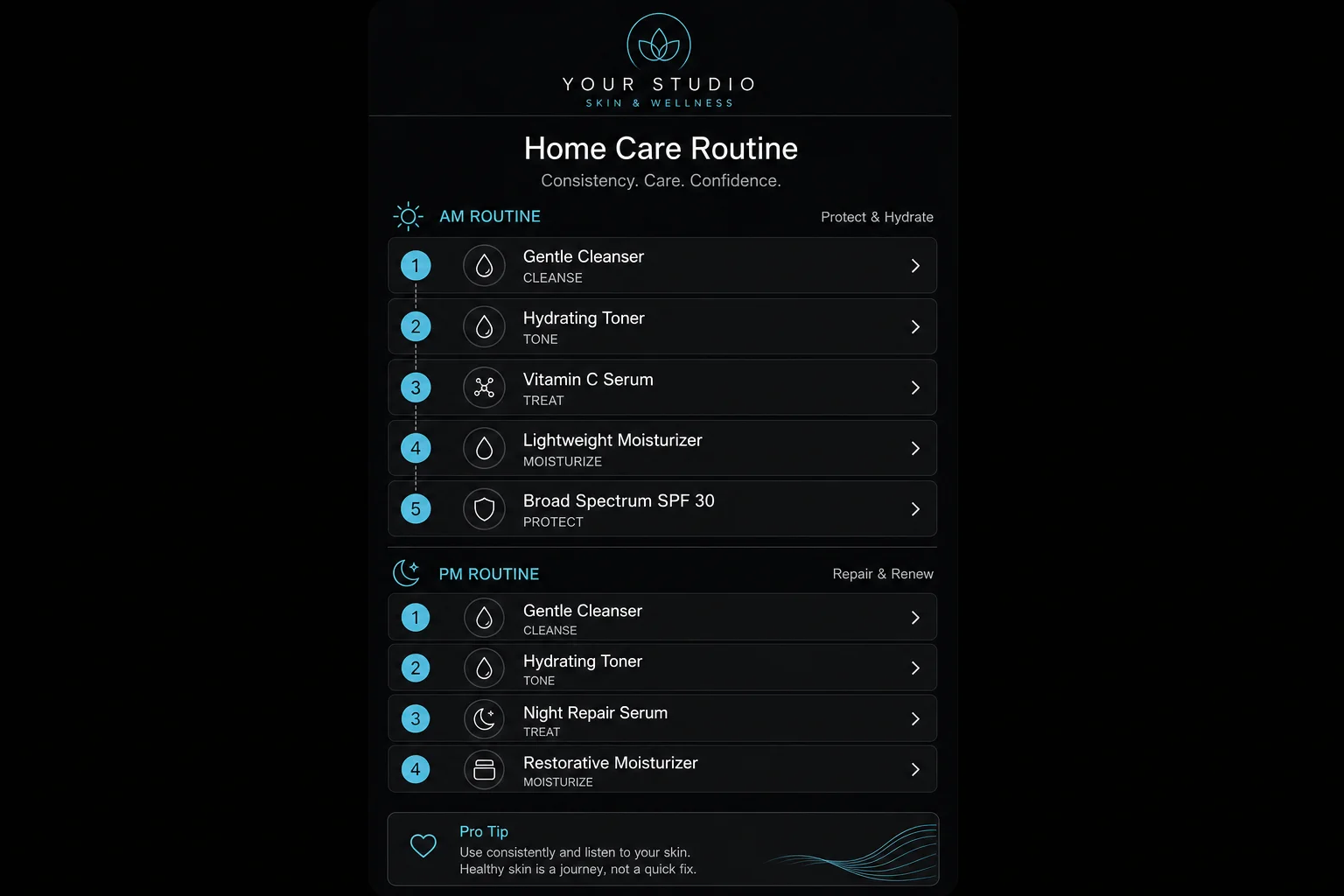
Part of the ASO Work App — the operating layer around a spa booking platform.
Operational problem
The moment a client leaves a facial is when results start to slip — because aftercare fails, not because the treatment failed.
Verbal instructions evaporate. Generic printed sheets do not match the esthetician's protocol for this client on this visit. Wrong product order, confused AM/PM, active ingredient used too early. Six weeks later she does not rebook: "the products didn't really work for me."
The esthetician spent 60–90 minutes on a protocol-grade treatment. The home care handoff deserved the same professionalism.
Why it mattered
Retention and rebooking depend on what happens at home — and on the client believing the treatment worked. When follow-through is informal, the practice absorbs blame for product failure that was really a communication failure.
There is also a retail angle. The esthetician recommends specific products for specific reasons. That recommendation disappears with a verbal handoff. A saved, searchable routine is also the foundation for knowing when to prompt a reorder — turning a one-time recommendation into recurring retail revenue.
What system was built
A homecare composer inside the staff dashboard, connected to the client CRM and product catalog. The esthetician builds a named, dated routine at checkout — AM and PM steps, catalog products (not free-typed names), and notes — then sends it in one action.
Composer and templates
Select the client from the CRM, then load a template for their skin type or concern — or build from scratch. AM steps and PM steps are structured grids: step category, frequency, and product selected from the catalog (no misspelled names; products are the same objects tied to actual inventory). A notes field captures the clinical reasoning that does not fit the grid.
Templates for common presentations — acne, aging, sensitive, post-peel — save 5–10 minutes per client, especially useful for new clients or when a different practitioner takes the appointment.
Routines save per visit. The history builds across appointments: every return visit has a full record of what was prescribed before and why.
Delivery
One click after saving. Email and SMS preferences are remembered per client. Klaviyo delivers a branded email plus the client page link.
The client receives a mobile-optimized page: studio logo, her name, visit date, AM and PM step cards, a print button, and a color palette matched to the practice. No app download, no account, no login required.
The link does not expire. When the protocol updates on a return visit, the same URL reflects the new routine — the client is not hunting through old messages.
Routine history and clinical record
Every routine is saved against the client record in Supabase. Staff can view, edit, resend, or archive from the routine library. Over time this becomes a clinical protocol record: what was prescribed across multiple visits, what changed, and why.
Practitioner continuity benefits too. If a different esthetician takes a returning client, the full prior protocol is visible — not just the last visit, but the progression.
Replenishment and cart (in progress)
Products carry an estimated replenishment window — 8 weeks for a daily SPF, 12 for a serum, variable by product. When that window approaches, the system batches clients whose products are likely running low and triggers a gentle prompt: "According to our records, you may be running low — click to reorder, or reach out to adjust your routine."
Each recommendation will link directly to the product on Shopify. The future state is a saved cart embedded in the routine link itself: one click builds the reorder basket from the esthetician's existing recommendation, no re-selection needed.
The goal is recurring retail revenue from recommendations already made, without requiring the client to remember to come back.
Practical / measurable result
Clients leave with something they can actually use at 6am three months later — not a conversation they half-remember. Return traffic to routine pages weeks after appointments confirms the handoff stuck.
The routine history builds a protocol record that makes every return visit better-informed, and sets up the replenishment follow-up system currently in progress.
What this pattern applies to
Any service business where outcomes depend on client behavior after the visit: skincare, aesthetics, clinical-adjacent wellness, hair care, coaching protocols. Especially where rebooking correlates with product results, and where "the product didn't work" is more often "the client didn't know how to use it."
Technical details
Part of the ASO Work App codebase. Staff composer in Next.js + Supabase. Products sourced from Boulevard catalog API today; migrating to Shopify as source of truth. Tokenized client URLs without accounts. Delivery via Klaviyo (email + SMS). Templates stored per practice. Send preferences persisted per client. Full routine history in Supabase, linked to client CRM records.
Zero friction on the client side. Full protocol record on the practice side. The esthetician's judgment survives the parking lot.