Operational problem
Construction consulting work involves plan review, measurement, takeoff, and bid documentation on a recurring basis. The tools that handle this cleanly — full-featured PDF markup and takeoff platforms — are priced for enterprise teams and built around subscription seats. For a consultant who does this work regularly but not at enterprise volume, the economics and the workflow do not fit.
The deeper operational problem is continuity. When measurements live in one tool, markups in another, and quantities in a spreadsheet with no link back to the geometry, the reasoning behind a takeoff is invisible. Plans revise; the numbers drift. Work done on a prior job is not referenceable without reassembling scattered files. A bid package handed to a subcontractor carries quantities without context.
What was needed: a single workflow that keeps calibration, measurement, markup, quantity notes, and the estimate together — on the machine where the plans already live, without requiring connectivity on bid day.
What was built
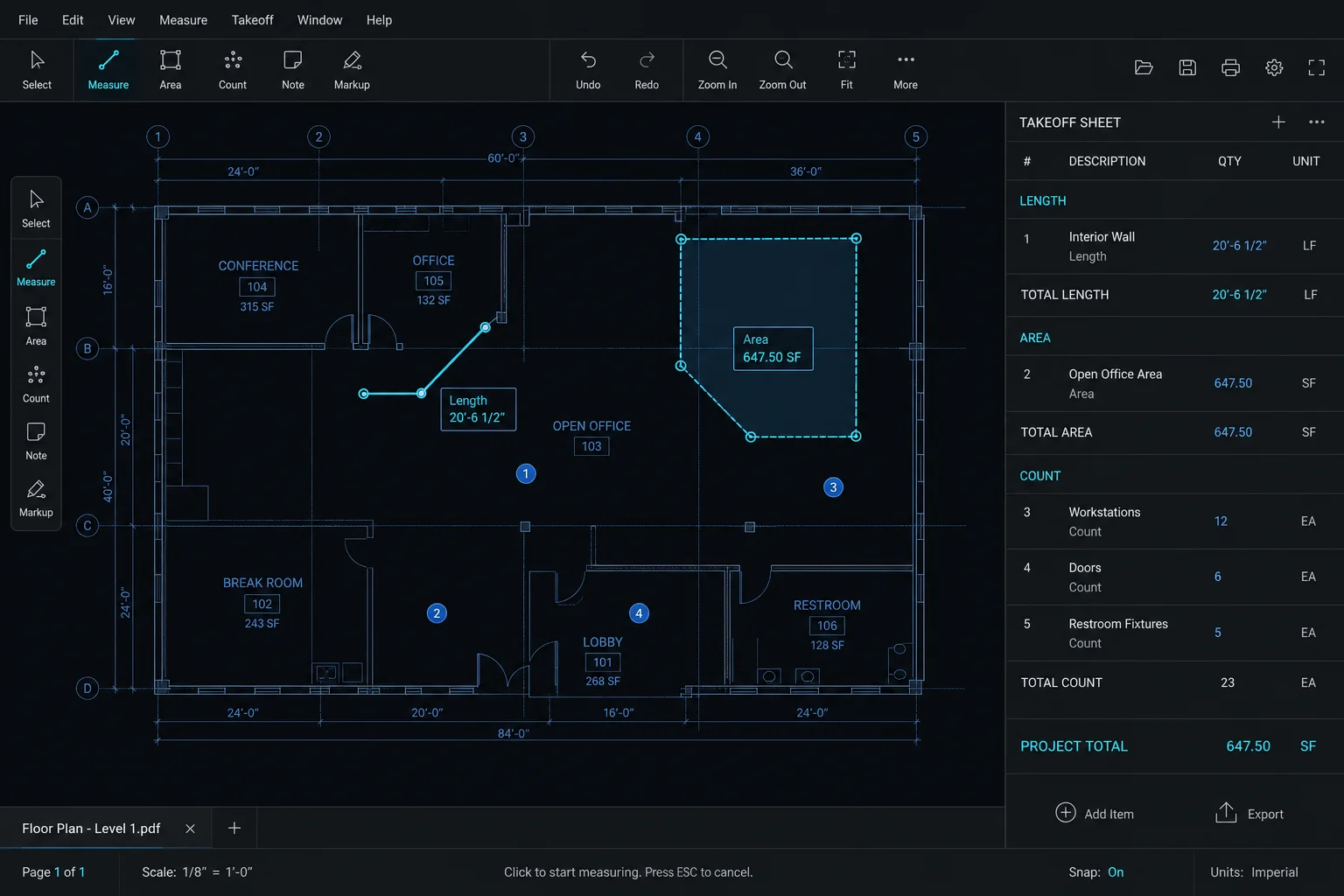
Takeoff PDF is a self-contained Windows application for plan PDF workflows: splitting and merging multi-file sets, marking up drawings, annotating components, calibrating scale per page or document, performing geometric takeoff, and building a lightweight estimate alongside the measurement work.
The core feature is that everything stays together. Markups link to quantity notes; quantity notes link to line items in the estimate template. When a plan is revised, the project file travels with it. The reasoning behind each measurement — why this area was counted this way, what the assumption was for a particular scope item — is part of the project, not part of someone's memory.
How the workflow runs
Plans come in as PDFs — a common set for a residential or light commercial project might be split across multiple files or arrive as one large document. Takeoff PDF handles splitting and merging as a first step, so the working set is organized before measurement begins.
Scale calibration happens once per page (or once for the document when scale is consistent). Every measurement after that point is in real units, not pixels.
Measurement tools cover the standard takeoff geometry: polylines for linear quantities, polygons and areas for surfaces, count tools for individual components. Markups and annotation clouds appear directly on the plan and flatten into the exported PDF.
The estimate layer captures quantities, categories, and notes alongside the drawings. Line items in the takeoff sheet can link back to specific markups so the connection between the measurement and the number is explicit, not assumed.
Before export, the app flags unscaled pages, unlinked markups, and empty quantity fields — not errors that block export, but visible signals that help the estimator decide consciously what goes into the bid package.
The exported PDF is standard — any viewer can open it. Subcontractors, owner's representatives, and reviewers do not need Takeoff PDF to read the marked-up drawings.
What this pattern applies to
Residential and light commercial general contractors doing in-house estimating. Owner's representatives checking sub quantities. Trade contractors measuring from plan PDFs. Construction consultants who need takeoff capability without enterprise per-seat pricing.
Also useful for anyone whose current workflow separates measurements from the plans they came from — the operational problem of disconnected tools is not unique to large projects.
The tool is not currently for sale but is under consideration for release.
Technical details
Built with Tauri 2 (Rust) + React 19. PDF rendering via PDF.js; markup layer via Konva; project state in SQLite for portable .takeoff project files. NSIS installer for Windows. Multi-page viewer, per-page or per-document scale calibration, full markup toolset, linked takeoff sheet, marked PDF export. Local Pro license validation via Rust backend.
For teams currently on per-seat PDF tools (e.g. Bluebeam at ~$449/seat/year), the economics are relevant context — but the reason to use this is workflow continuity, not cost avoidance.
Plans, measurements, markups, and quantities in one file — because the reasoning behind a takeoff matters as much as the numbers.